Blog
AI Readiness Assessments: Essential for Businesses Before Starting AI Initiatives
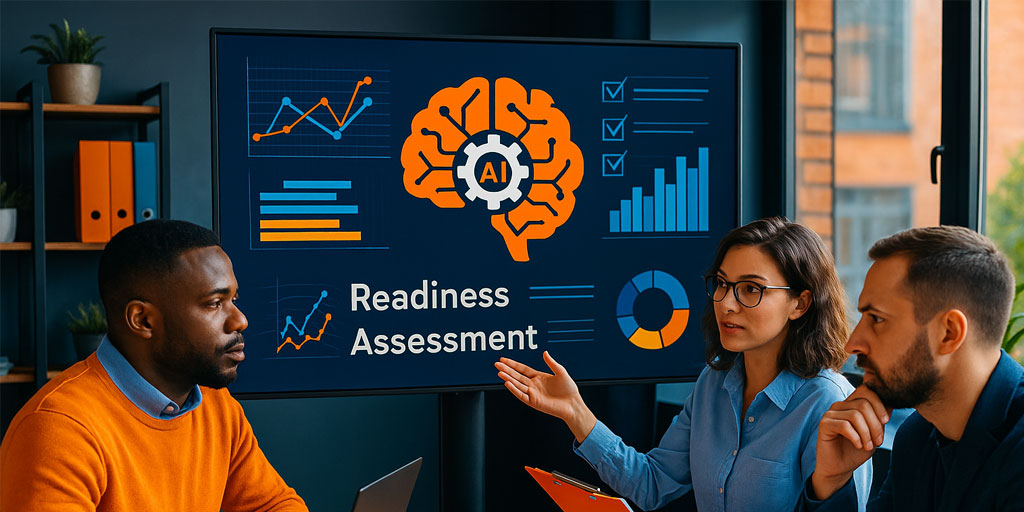
You wouldn’t build a house without checking the foundation. Similarly, before diving into an AI project, it’s wise to assess if your business has the right foundation to support and benefit from AI. That’s where an AI readiness assessment comes in. It’s essentially a structured evaluation of how prepared your organization is to implement and sustain AI solutions successfully. In this article, we’ll explain what AI readiness assessments entail, why they are essential (especially given the high failure rate of unguided AI pilots), and how you can conduct one to set your AI initiatives up for long term success.
Why Do an AI Readiness Assessment?
Many organizations are eager to apply AI which is great. But enthusiasm alone isn’t enough; numerous studies and industry experiences have shown that lack of preparation leads to stalled or failed AI projects. For example, one report found that 88% of AI POCs never reach production due to factors like insufficient data readiness and lack of expertise. An AI readiness assessment helps you identify those potential stumbling blocks upfront so you can address them beforehand. Think of it as a “preflight checklist” before you launch an AI project.
Key reasons to do an assessment:
- Avoid Wasted Investment: AI projects can be resource intensive. If your data isn’t in good shape or your staff isn’t trained, you might invest in a project that goes nowhere. The assessment highlights gaps to fix first. It’s far cheaper to improve readiness (e.g., clean your data, hire/train people) than to have a big AI implementation flop because something critical was missing.
- Increase Chance of Success: Assessments correlate strongly with success. Organizations that systematically evaluate and plan tend to achieve their AI goals more often. It’s partly about setting realistic expectations too the assessment might reveal you’re not ready for a sophisticated predictive AI, but you could start with simpler automation. Better to know that at the start.
- Strategic Alignment: The process forces you to articulate why you want AI and where it would add value, aligning with business priorities (this was highlighted in Article 1 on starting an AI journey). It ensures AI efforts aren’t just tech for tech’s sake, but tied to clear business outcomes. Leadership commitment is gauged too which is critical, as AI readiness isn’t just technical; it’s organizational.
- Baseline Measurement: If you plan to grow AI capability, an initial assessment gives you a maturity baseline. You can later reassess to measure progress. For instance, maybe you start at a “Level 1 exploring” in AI maturity and aim to reach “Level 3 implementing” next year. Having that framework helps track improvement.
In short, an AI readiness assessment dramatically improves the odds that your first (and subsequent) AI projects will deliver ROI instead of fizzling out due to preventable issues.
What Does an AI Readiness Assessment Cover?
While frameworks vary, most assessments examine several common domains. Based on research and industry best practices, here are the typical pillars:
- Strategy Alignment: Do you have a clear AI strategy or at least defined objectives for AI? Is there executive support? AI projects need to serve actual business goals (e.g., reducing costs, improving customer experience). The assessment checks if you have identified use cases with value potential and if leadership is on board to champion them. If not, that’s a gap many recommend starting with an AI strategy workshop or including AI in broader digital strategy.
- Data Readiness: This is a big one. Is your data of good quality, accessible, and relevant for AI? AI, especially machine learning, thrives on data. Assessment looks at:
- Data availability: Do you have the data needed for the AI use case (e.g., customer transaction histories for a churn model)?
Data quality: Is it accurate, complete, consistent? Or is it full of errors and gaps? - Data infrastructure: Can you easily retrieve and work with the data? (Do you have data warehouses, lakes, pipelines in place, or is data siloed in systems that don’t talk to each other?)
- Data governance: Are there policies, and compliance considerations (who owns the data, can it be used for AI under privacy laws)? Without governance, even if data exists, you could run into legal issues using it.
- The assessment might score you on these aspects or provide a checklist. Many companies find out here that, for example, they need to invest in data integration or cleaning before AI will be viable. A common quote is “garbage in, garbage out” readiness checks aim to ensure you don’t feed garbage data to your AI.
- Data availability: Do you have the data needed for the AI use case (e.g., customer transaction histories for a churn model)?
- Technology and Tools: Beyond data, do you have the tech stack to build and deploy AI? This includes:
- Computing resources (Do you have access to cloud services or on Prem hardware like GPUs for training models?).
- AI software/frameworks (Are you set up to use popular libraries or platforms? Many cloud providers have readymade AI services are those in your environment or can they be, if needed?).
- IT infrastructure to integrate AI outputs into workflows (For example, if you build a model, can it connect to your production systems easily via APIs or similar?).
- MLOps readiness (MLOps = machine learning operations tools and processes for maintaining models, similar to DevOps for software. It’s an advanced readiness factor; most early stage orgs won’t have this yet, but an assessment might note it as something to plan for if scaling AI).
- If technology is lacking, the assessment will highlight needs like migrating data to the cloud, acquiring certain software, or augmenting security for AI tools, etc.
- Skills and Talent: Do you have people with the necessary expertise to execute AI projects? Key roles typically include data scientists, data engineers, ML engineers, business analysts who understand AI, etc. If you don’t have them internally, is there a plan to hire or partner? Also, beyond specialists, are your general staff data literate enough to work with AI outputs (Article 7 mentioned workforce augmentation employees need some AI literacy). According to one source, 68% of CEOs cite lack of AI talent as a barrier. The readiness check will assess current skill levels:
- Does your IT team have any experience with AI/ML?
- Are business units knowledgeable about how to identify good AI use cases and interpret AI driven insights?
- Is there a training or recruitment plan to fill gaps?
- If the assessment finds a gap, strategies might be recommended like training programs, bringing in consultants for initial projects, or creating cross functional teams (business + tech) to ensure knowledge transfer.
- Organizational and Culture: AI adoption isn’t just about tech; it often requires process changes and a data driven culture. The assessment might use surveys or interviews to gauge:
- Leadership and stakeholder buy in (Would people trust an AI’s recommendations? Are managers supportive or wary?).
- Culture of innovation vs. fear of new tech (Are employees empowered to experiment with new tools or do they resist?).
- Silos vs. collaboration (Successful AI often needs cross department collaboration, e.g., IT working closely with marketing on a customer analytics model).
- Change management readiness (Does the org have a track record of adopting new digital tools successfully? If AI recommends a different decision than traditional methods, will staff override it or accept it?).
- If culture is not ready, the assessment will flag the need for change management efforts. For instance, maybe you need to do awareness programs on what AI is (and isn’t) to dispel misconceptions and get people excited instead of threatened. Or set up an AI center of excellence to evangelize and support projects, showing that leadership is serious about AI.
- Governance and Ethics: This is increasingly part of readiness given regulatory trends. Before starting AI, do you have frameworks to ensure it’s used responsibly? The assessment checks:
- Awareness of regulatory requirements (depending on industry: e.g., data privacy, algorithmic fairness laws, etc.).
- Any existing policies on data usage, model validation, human oversight of AI decisions.
- Plans for ethical guidelines (e.g., will you have an ethics review for AI use cases to filter out problematic ones?).
- Many orgs early on won’t have these formalized that’s okay, but the assessment will likely recommend establishing some governance structure (even if light) before deploying AI widely. E.g., designate someone to be responsible for AI oversight, commit to bias testing any critical models, put in place a process for handling AI errors or appeals, etc.
Each of these areas might be scored on a maturity scale or simply flagged as Green/Yellow/Red readiness. For example, you might find:
- Strategy: Green (clear vision, CEO is sponsor),
- Data: Yellow (have a lot of data but quality issues and siloed needs work),
- Tech: Yellow (some cloud infra but no ML tools installed moderate readiness),
- Skills: Red (no data scientists on staff, urgent need to hire or partner),
- Culture: Yellow (generally data friendly but pockets of resistance need education),
- Governance: Red (no thought given yet to ethics or compliance must address minimal viable governance).
This snapshot helps prioritize what to fix before diving into development.
How to Conduct an AI Readiness Assessment
If this sounds a bit heavy, don’t worry it can be scaled to your context. There are a few ways:
- Self-assessment using frameworks/checklists: Many consulting firms and tech companies have published AI readiness checklists or questionnaires. For instance, you might find a “20-question AI readiness quiz” covering each area. Microsoft’s AI Business School or Google’s Cloud AI readiness docs might offer guidance. Answering those questions internally (maybe via workshops) can give a qualitative sense of readiness. For more rigor, there are frameworks like the “AI Maturity Model” which break down levels across dimensions. One source suggests categories like exploring, planning, implementing, etc., as stages you can identify which stage you’re in.
- External assessment service: If budget allows, you could engage a consulting firm or expert to do a formal readiness assessment. They would interview stakeholders, review your systems and data, and deliver a report with findings and recommendations. This can be valuable because they know what best-in-class looks like and can benchmark you. On the flip side, smaller businesses might find this overkill or pricey. But some vendors offer it as part of their AI solution sales (e.g., an AI vendor might assess you to ensure if you buy their product it’ll succeed).
- Focused pilot assessment: Another approach is to pick a specific use case you want to implement, and do a mini readiness check around that. E.g., if you want to deploy an AI chatbot for customer service, assess specifically: Do we have the historical chat data to train it? Is our customer service team prepared to integrate it? Do we have a platform to host it? This is narrower than enterprise-wide readiness, but very practical for ensuring a pilot doesn’t run into a wall. Often, early pilots double as learning experiences that surface readiness issues to then address for broader rollout (like discovering your data quality sucks when the model’s results are bad).
- Use adoption metrics as part of readiness: If you’ve done other digital transformations, some readiness can be inferred. For instance, if your company successfully adopted a big data analytics platform last year and people are using data in decisions, that’s a good sign for AI readiness on culture and data fronts. So a tip is to leverage existing IT governance or digital maturity assessments you might have and add AI-specific criteria to them.
Once conducted, you should have a clear list of strengths and gaps:
- Strengths maybe you have plenty of data and strong executive support (great, lean on those).
- Gaps maybe you lack skilled staff and your data is partly messy.
Then comes action planning:
- For each gap, define remediation steps with a timeline and owners. For example, “Hire 2 data scientists by Q3,” “Implement data validation on critical datasets over next 6 months,” “Run AI ethics workshop with legal and compliance to draft guidelines,” “Invest in a cloud ML environment or identify vendor solution IT to evaluate options by Q2,” etc.
- Some fixes are quick (like enabling a data integration feature you already have license to, or sending a few people to AI training), others are long (hiring or major data overhaul). Prioritize the ones that are prerequisites for any success (data issues usually top that list no point doing AI until key data is accessible and reasonably clean).
- Set a realistic timeline. It might be that you plan a small AI pilot in parallel while working on bigger readiness fixes (this is common you don’t have to halt all AI until everything is perfect, but be mindful to choose a pilot that fits current readiness or can be done while improvements are underway).
Crucially, the assessment should be candid. If it basically says “you’re not very ready right now,” it’s better to accept that than to push ahead blindly. It’s fine to start small if readiness is low e.g., do a rule based automation first (maybe not even machine learning) to get data pipelines and team experience, then gradually increase sophistication. According to a LinkedIn piece, overestimating readiness is a common pitfall, so avoid that trap by trusting the assessment insights.
Conclusion: Making Readiness a Continuous Practice
AI readiness assessment isn’t a onetime checkbox; it can become a periodic exercise. As you complete initial AI projects, do a follow-up assessment to see how far you’ve come and what new gaps might emerge at scale (perhaps your pilot had no governance issues because it was small, but as you consider deploying AI broadly, governance becomes urgent).
In summary, an AI readiness assessment is an essential first step for any organization serious about AI adoption. It brings together stakeholders to honestly evaluate where you stand on strategy, data, tech, skills, culture, and governance. By doing so, you gain a clear roadmap of preparatory actions that will make your AI initiatives far more likely to succeed and deliver ROI (and avoid the scenario of an 88% failure rate).
Think of it as investing in groundwork. It might delay your project kick-off a bit, but that groundwork will save you time, money, and headaches later. With solid readiness, you can proceed with confidence into the exciting world of AI, rather than tiptoeing on shaky ground.
FAQ: AI Readiness Assessments
Q: We’re eager to start an AI project now. Do we really need to pause for an assessment?
A: It’s tempting to dive right in, especially if competitors are doing AI. But an assessment doesn’t have to be a huge, time-consuming process it can run in parallel with initial exploratory work. You don’t necessarily “pause” everything; you can, for example, spend a couple weeks doing a quick assessment while also brainstorming AI use cases. The benefit is that the assessment might steer you toward a better first project or warn you of something to fix early. If you absolutely have a pressing AI project, at least do a Mini assessment focused on that project’s needs. For instance, before building an AI marketing campaign tool, quickly audit your marketing data and team’s skills say in a few days. Skipping assessment is like not doing requirements gathering before a software project you could just start coding, but risk of rework or failure is high. Many veteran AI folks have seen pilot after pilot fail due to things an assessment would catch (e.g., no executive champion so the project loses support, or data wasn’t actually available to train the model, etc.). So, you don’t necessarily need a month-long study, but do some form of readiness check. Think of it as due diligence to protect your investment. If you’re extremely confident (perhaps your org is very digitally mature already), you might streamline the assessment, but I’d still recommend documenting assumptions about readiness and validating them (for example: “We assume our customer data is integrated and clean enough for this let’s verify that in the first week, and if not, pivot accordingly.” That itself is an assessment mindset). In short, fast-track the assessment if needed, but don’t skip it outright. The hour or two spent with key stakeholders asking “Are we sure we have X, Y, Z in place for this project?” can save you many hours later.
Q: Our company is small can we just assess informally? Formal assessments sound like what big enterprises do.
A: Absolutely, for a small or midsize business, an informal assessment is fine the key is to think through those readiness categories systematically, not that you produce a fancy report. You might do it in a single meeting with the leadership team or relevant staff. For example, gather the head of operations, IT (even if that’s part-time or an external consultant), and any data savvy folks, and go through questions like:
- What business goal do we want AI to tackle first? Is everyone aligned on that?
- What data do we have related to that goal? Where is it, is it complete, who controls it?
- Do we have someone who knows how to work with data/AI? If not, how will we get that help hire a consultant, train someone, use an AI service that requires less expertise?
- How will this change our current process are the team members open to using an AI tool or result? (If, say, a salesperson might get a lead score from AI, will they trust it?)
- Are there any compliance or customer trust issues if we use AI in this use case? (E.g., if AI emails customers, should we disclose it’s AI-generated? Are we comfortable with that?)
That could be done in an hour or two of discussion (which is effectively an assessment). Capture the notes: e.g., maybe IT says “Our data is in two systems, we’d need to merge it that might take a month.” Now you know a timeline factor. Or you realize no one knows machine learning so maybe start with a simpler rules engine or use an AutoML tool. Small companies often have simpler structures, so readiness can be gauged quickly. And you may have fewer legacy issues; sometimes small firms are more nimble data-wise, or everyone is on one software, which is a plus. The danger for small orgs is lack of specialized talent which your informal assessment will highlight and you can plan around (maybe partnering with an AI vendor who provides support or using more out-of-box solutions).
So yes, skip the corporate formality, but do go through the content of an assessment. Even a one page checklist you tick off can suffice. And remember, you can reach out to industry peers or small biz networks sometimes they have templates or can share how they assessed readiness. The key is awareness of what’s needed. If after your informal check you feel, “We have our data in Excel and one eager analyst who took an online ML course, and leadership is willing to give this a shot on a small scale” that might be enough readiness for a small proofofconcept. Just set expectations accordingly (maybe you won’t build a cutting-edge neural network, but you could automate a report or create a simple predictive model with available tools). Start with that, and success there will improve readiness for the next, bigger project. In summary, tailor the assessment to your size: it can be quick and conversational, but don’t skip the thinking exercise. It will make your approach more solid.
Q: We did an assessment and found many gaps. How do we avoid this becoming a paralysis like having to fix everything before doing any AI?
A: This is a great point. It’s possible an honest assessment uncovers a lot of homework that can feel overwhelming. The solution is prioritization and parallel tracks:
- Prioritize Gaps by Impact: Some readiness aspects are must-haves, others can be improved on the fly. For example, if you literally have no usable data, that’s a stop sign: you must address that before expecting any AI result. But if the gap is something like “no formal AI governance policy” you can start a pilot while in parallel drafting a simple policy, as long as the pilot is low-risk. Or if skill is lacking, you might partner with someone to start the project while simultaneously training/hiring for longer term. So identify which gaps are showstoppers vs. manageable risks.
- Scope a Feasible Pilot: Often, you can find an AI application that fits within your current constraints. Maybe your aspirational project needs five things fixed, but another simpler use-case needs only one gap addressed. For instance, full customer personalization AI might need tons of data and an advanced model (beyond current capability), but a simpler AI that, say, classifies customer emails into categories might be doable with current email data and a basic ML service. That smaller win improves data practices and gets staff warmed up, while you work on bigger gap fixes for the large project. Crawl-walk-run approach.
- Parallel Workstreams: Break the preparation tasks into streams that can run in parallel to starting something tangible. E.g., you decide to go ahead with a small pilot, while concurrently IT is improving the data pipeline and HR is recruiting a data engineer. By the time the small pilot is done, you’ll be in better shape for the next one.
- Leverage External Help: If gaps are big but you want to move now, consider external resources to bridge temporarily. For example, lacking infrastructure? Maybe use a cloud platform that abstracts a lot of it, so you don’t have to build from scratch. No in-house AI expertise? Hire a consultant to develop the first model and mentor your team. This can prevent paralysis you get moving while also learning/ building internal capability gradually.
- Set Realistic Phases: Create a roadmap that has phase 1 (with current partial readiness), phase 2 (after certain improvements), etc. Communicate to stakeholders that phase 1 will deliver X with the current state, and phase 2 (maybe 6 months later once ABC are fixed) will deliver Y (more advanced). This way everyone knows progress is iterative. It avoids the trap of “we must be at perfect readiness before doing anything” instead, it’s “we’ll do what we can now, and more as we grow.”
- Secure Leadership Support for Investments: Sometimes gaps require investment (like buying a data integration tool or hiring staff). Use the assessment findings to make a case. Leadership might be more willing to invest if they see a clear plan: e.g., “We’re not AI-ready in data, so we need to implement a data warehouse cost X but this will enable Y use-cases yielding Z value.” Showing the link between readiness fixes and business outcomes helps avoid just shelving AI plans in defeat. It becomes an improvement project with purpose.
- Quick Wins: Try to include at least one quick win project that can demonstrate value in the short term, however modest, while you work on bigger readiness gaps. This maintains momentum and proves the concept. For example, automate a simple report with AI or use a prebuilt AI service to solve a minor problem. Even if it’s small, that success can galvanize support to fix the bigger foundational issues (people see that “hey, AI gave us something useful, imagine if we had our data act together, we could do much more”).
It’s a balance: you don’t want to ignore glaring deficiencies and doom a serious project, but you also don’t want to sit idle for a year “preparing” without any AI in action (which can kill enthusiasm or let competitors leap ahead). So, use the assessment as a guide to mitigate risk not as an excuse to delay forever. Address critical needs as priority, start small where possible, and concurrently build capability for the future. That way, you turn the readiness exercise into a roadmap rather than a roadblock.
Latest Blog
Enjoyed this? There's more where that came from. Explore more perspectives from Contata's team on AI, data, and modern application development.
.png)